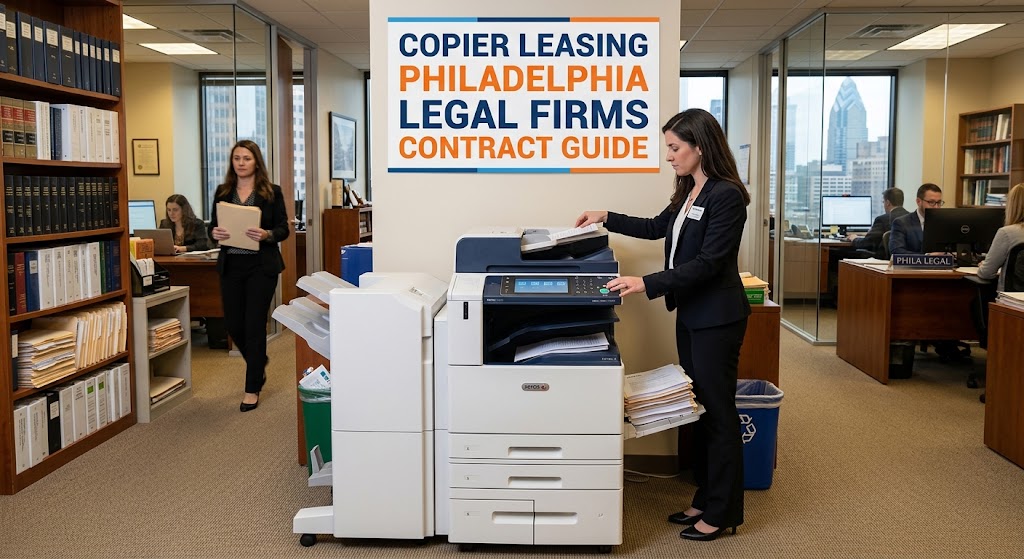
Copier leasing Philadelphia legal firms need to be evaluated by more than the monthly payment, because a low quote can hide costly renewal terms, service limits, and per-page charges. For managing partners, administrators, and finance teams, the better approach is to compare the full lease contract, service-level agreement, security features, and expected print volume before signing. This makes it easier to choose equipment that supports court deadlines, confidential files, and changing legal workloads.
A Legal copier lease agreement Philadelphia firms can manage confidently should define equipment, usage, service, security, pricing, renewal, and end-of-term obligations in clear language. The right contract should also match actual black-and-white and color printing needs instead of relying on broad estimates. This guide explains how legal offices can evaluate those issues and negotiate a more predictable copier arrangement.
What Contract Clauses Should Philadelphia Law Firms Watch Closely?
Copier leasing Philadelphia legal firms contracts should clearly identify the equipment, lease term, monthly payment, service agreement, usage allowance, and end-of-term requirements. The most important clauses are usually the ones that explain what happens when the initial term expires or when monthly printing exceeds the agreed allowance. A strong review process checks every financial and operational obligation before the agreement is signed.
A law firm copier lease Philadelphia contract should receive particular attention when it contains an automatic renewal or evergreen provision. A 12-month auto-renewal can extend the arrangement if the firm misses a notice deadline, while an annual maintenance increase can raise operating costs even when the equipment itself has not changed. Firms should also check whether the contract separates equipment payments from service fees and whether either portion can increase during the term.
Contract clauses worth reviewing
| Clause | What to check |
| Lease term | Exact start and end dates |
| Auto-renewal | Renewal period and cancellation deadline |
| Evergreen language | Whether the agreement continues automatically |
| Price escalation | Annual maintenance increase and cap |
| Usage allowance | B&W and color page limits |
| Overage charges | Per-page rates after the allowance |
| Early termination | Fees and remaining obligations |
| Equipment return | Condition, shipping, and timing requirements |
| Data security | Drive wiping and documentation |
A legal copier lease agreement Philadelphia firms are considering should make cancellation procedures easy to find and understand. The agreement should state the notice period, renewal date, early-termination charges, equipment-return requirements, and any remaining financial obligations. Before signing, administrators should ask the provider to explain every clause that could continue the agreement or increase the firm’s costs.
What Service SLA Should a Philadelphia Law Firm Expect?
A law firm copier lease Philadelphia provider should clearly define the difference between remote support, technician dispatch, and guaranteed onsite response. For many high-volume legal offices, a negotiated 2-to-4-hour guaranteed onsite response can provide a stronger service benchmark than a vague promise of “fast service.” The contract should also state whether the response clock starts when the ticket is opened, when the issue is diagnosed, or when a technician is dispatched.
A legal copier lease agreement Philadelphia firms sign should also address what happens if a repair cannot be completed promptly. Important metrics can include onsite response time, first-visit resolution, parts availability, preventive maintenance frequency, escalation procedures, and loaner or replacement equipment policies. The goal is not simply to get a technician onsite, but to reduce the amount of time the firm cannot reliably print, copy, or scan.
SLA metrics to negotiate
- Onsite response time: preferably a defined target or guarantee
- Repair escalation: clear process for recurring failures
- Parts availability: expectations for commonly needed components
- Preventive maintenance: scheduled service intervals
- Remote monitoring: automatic alerts for errors and supplies
- Loaner equipment: conditions for replacement equipment
- Resolution tracking: documented service history
A useful negotiation question is: What standard service SLA response time should a Center City Philadelphia law firm expect? A provider should be able to answer that question with a specific response target rather than a general statement about customer service.
How Philadelphia Law Firms Can Audit Print Volume and Avoid Overage Fees?
A law firm copier lease Philadelphia proposal should separate black-and-white and color volume whenever the contract uses different rates for each type of page. A firm that accepts an overly high color allowance may pay for capacity it rarely uses, while a firm with heavy color requirements may face expensive overages. The best estimate comes from several months of actual meter readings rather than a single month’s activity.
A simple print-volume audit
- Collect 6–12 months of available meter data.
- Separate black-and-white and color pages.
- Identify unusually high litigation or transaction months.
- Calculate the average monthly volume.
- Compare the average with peak demand.
- Review the proposed included allowance.
- Calculate the cost of expected overages.
- Recheck the numbers before signing.
A legal copier lease agreement Philadelphia contract should make overage calculations easy for the finance team to audit. Firms should record monthly meter readings, compare actual pages with contracted allowances, and track unusual litigation or transaction periods that explain volume spikes. This is especially important when cost per page overage fees law firm printing become a significant part of the monthly invoice.
How Philadelphia Law Firms Can Choose a Better Copier Lease
Copier leasing Philadelphia legal firms decisions should start with the contract, not the advertised monthly payment. The most important areas to examine are automatic renewal clauses, maintenance price increases, service response commitments, print allowances, overage rates, security controls, and end-of-lease data handling. A right-sized agreement can give a legal office more predictable costs while supporting secure and reliable document workflows.
A legal practice can contact Clear Choice Technical Services at (215) 297-6363 to discuss equipment options, print-volume requirements, service expectations, security needs, and lease terms. The goal is a copier solution that supports confidential legal work, predictable operating costs, and dependable day-to-day productivity.
Before signing a copier contract, ask for a complete proposal that clearly shows the equipment payment, service costs, page allowances, overage rates, renewal terms, SLA commitments, and end-of-lease requirements.